Sciatica: what it is, when it is serious and how I work
Sciatica usually causes pain down one leg, sometimes reaching the foot. I’m Juan Manuel Morales Tamajón, an osteopath in San Pedro de Alcántara. To arrange an appointment, message me on WhatsApp or call; your first visit is the Comprehensive Body Assessment.
Clinic in San Pedro de Alcántara, by appointment only · Home visits in San Pedro, Marbella, Benahavís and, with prior notice, Estepona
Comprehensive Body Assessment €70 at the clinic · €120 at home
Phone +34 672 29 91 22
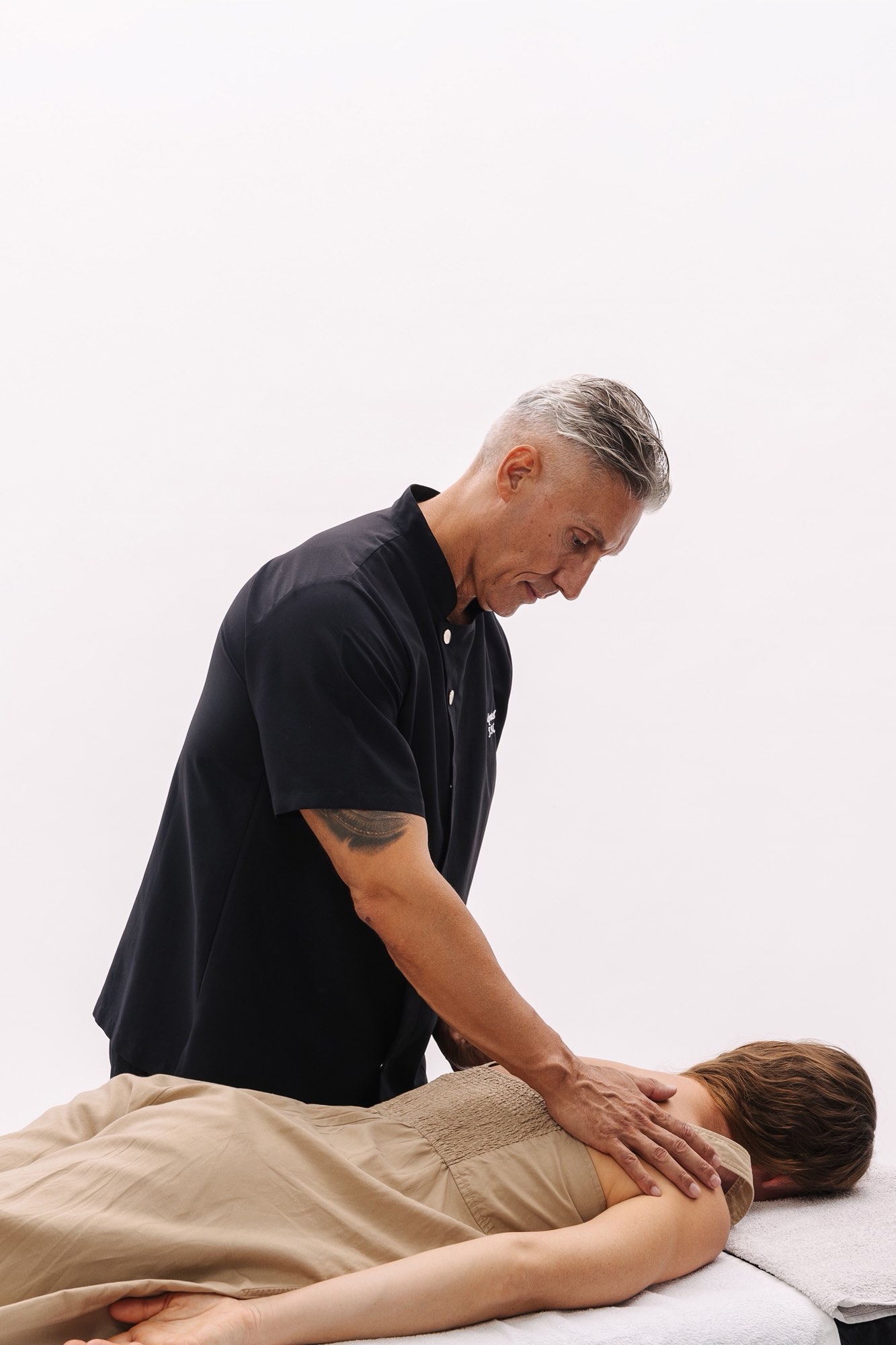
In short
- Sciatica is a symptom of another health problem, not a disease in itself.
- It usually affects one buttock and one leg.
- It tends to improve over weeks or months, but can last longer or return.
- It is advisable to move as much as you can and avoid spending too long in bed.
- Some signs mean you need to call 112 or go to the emergency department.
What is sciatica?
Sciatica is pain along the leg caused by irritation or compression of the sciatic nerve, sometimes with tingling, numbness or weakness.
The nerve begins in the lower back and travels down the back of the leg towards the foot. Symptoms usually affect the buttock and the back of one leg, and may reach the toes.
Sciatica symptoms: what it can feel like
The pain may feel sharp, shooting or burning. There may also be weakness.
Symptoms can begin suddenly or develop gradually. Movement, a cough or a sneeze may make the pain worse. Sitting or standing can also aggravate it, as can straining when you open your bowels. Your back may hurt too, although the leg pain is usually stronger.
What causes sciatica
A herniated or slipped disc is the most common cause. Spinal stenosis is another possibility: this means a narrowing of the spinal canal. Spondylolisthesis describes a bone in the spine slipping out of position. A back injury can also affect the nerve.
Other causes include piriformis syndrome, involving a muscle in the buttock, and injuries or fractures of the pelvis.
The name describes where and how it hurts; diagnosis and tests belong to your doctor. Outside specialist care, imaging is not routinely recommended. Your doctor decides whether you need a scan based on your circumstances.
Is sciatica serious?
Usually not: it tends to improve with time, but it becomes urgent if the signs below appear.
How long does sciatica last?
Sciatica usually lasts a few weeks to a few months, but it can last longer. It can also come back after an earlier episode.
Loss of sensation, weakness and difficulty controlling your bladder or bowels need attention. They matter even when the pain has only just started.
When it is an emergency: cauda equina
At the lower end of the spinal canal is a group of nerve roots called the “cauda equina”, meaning “horse’s tail”. Compression or damage here can affect leg strength and control of urine or stools.
You may also lose feeling in the area that would touch a saddle: the genitals, anus and inner thighs. These signs need urgent assessment in hospital. Without urgent treatment it can cause paralysis of the legs. Do not wait for an osteopathy appointment.
When to make an appointment with your doctor
Speak to your doctor if an episode lasts beyond four weeks, differs from earlier episodes, is worse than before or prevents you from doing your usual activities. Unintentional weight loss also needs a medical review. You do not need to wait that long if symptoms are getting worse.
Seek medical attention promptly for unexplained fever with back pain, or pain that worsens when lying down or wakes you at night. Do the same for weakness or numbness in the buttock, thigh, leg or pelvis. For emergency signs, follow the box below.
When to see a doctor or call 112
Call 112 or go to A&E (urgencias) if any of these apply:
- Sciatica on both sides.
- Weakness or numbness in both legs that’s severe or getting worse.
- Numbness around or under your genitals, or around your bottom (anus).
- You find it hard to start peeing, cannot pee or cannot control when you pee.
- You do not notice when you need to poo or cannot control when you poo.
- Chest pain.
- The pain started after a serious accident, for example a car accident.
Do not drive yourself: ask someone to take you or call 112.
If you feel hot, cold, shivery or generally unwell, ask for an urgent appointment with your doctor today. Do the same if it’s severe pain that starts suddenly, or it’s getting worse quickly.
See your doctor if the sciatica has not improved after trying home treatments for a few weeks. See your doctor as well if it is getting worse or is stopping you doing your normal activities.
Osteopathy does not replace your doctor or any medication you have been prescribed.
What I do in a session and what your doctor decides
Osteopathy doesn’t treat symptoms or injuries; its purpose is to help people, working on the body as a whole, as one indivisible functional unit.
If you come with sciatica, I listen to how it began and ask about previous episodes and your doctor’s diagnoses. I ask how far the pain travels and assess your mobility and how you are overall.
My work consists of thorough, hands-on sessions, considering the body as a whole. I give you personalised posture advice and home exercises. I explain them during the session, and we practise together so you can ask me anything you need.
I do not promise results.
Diagnosis and medical decisions
I don’t diagnose or prescribe, and I don’t change your medication: that is for your doctor. I won’t interfere with your doctor’s decision. If I have doubts, cannot work in your case or something is outside my competence, I advise you to see your doctor.
In Spain, osteopathy is not listed in Ley 44/2003, the law that regulates the health professions.
Staying active with sciatica
As general advice, avoid sitting or lying down for long periods.
Staying active without forcing a movement
Gentle movement can begin early, within what you can manage. Keep up everyday activities as far as you can manage, following any advice from your doctor, and do not force a movement that makes your symptoms worse. If symptoms spread further down your leg, stop and seek advice.
You may need to reduce activity at first. The return to your usual activities is then gradual. Avoid heavy lifting and twisting your back during the first few weeks.
If you are unsure which activity fits your circumstances, speak to your doctor. Follow their instructions if you have had an operation or have another health problem.
If a warning sign appears, seek medical attention before trying any more movements.
Sciatica exercises: general information and four examples
These four movements are common examples of gentle mobility exercises, described and drawn for this page. They have not been chosen for your circumstances or for any specific cause of sciatica, and they are not a prescription from me. Which exercise suits you depends on your situation. If you are unsure, ask your doctor or another healthcare professional.
Before you start, read the warning signs box. Move slowly and stay within a comfortable range. Stop if pain increases, or if pain, tingling or numbness spreads further down your leg. Stop as well if pain starts or you feel unwell. If you are unsure because of a health problem, a recent operation or pregnancy, ask your doctor first.
In the drawings, grey marks the starting position and the dark line marks the end. Do not force yourself into the position.
Pelvic tilt
From a small lower-back curve to gentle contact with the floor. Start: lie on your back with knees bent and feet flat, leaving the usual small curve under your lower back. End: gently tilt your pelvis to bring your lower back towards the floor, then relax.
Lying on your front, up on your forearms
Chest raised with hips resting on the floor. Start: lie face down with your forehead resting. End: raise your chest onto your forearms, keeping elbows under shoulders, hips on the floor and your neck long.
On all fours: round and hollow back
From a gentle hollow to a rounded back. Start: place hands under shoulders and knees under hips, with your back gently hollowed and your gaze slightly forwards. End: slowly round your back upwards and lower your head, keeping the movement small.
Seated buttock stretch
From sitting upright to a slight forward lean. Start: sit on a stable chair with feet flat, then rest one ankle on the opposite knee. End: lean forwards slightly from the hips with a straight back, until you feel a gentle buttock stretch; then change sides. Do not do this if it brings on leg pain.
If you come with sciatica: what the first visit is like
-
You message me or call me
On WhatsApp or by phone, on +34 672 29 91 22. Tell me whether you prefer to come to my practice in San Pedro de Alcántara or for me to come to your home.
-
I observe you and listen to you
I ask how and when the pain started, whether it has happened before and whether it keeps coming back. I also ask whether a doctor has diagnosed disc bulges or herniations, and how far down your leg it spreads. Then I assess your mobility and how you are in general.
-
A first hands-on session
I do a first hands-on session. I don’t work on one isolated area on its own: I look at your body as one single, indivisible unit. It isn’t possible to work in every case.
-
When I recommend seeing your doctor
If I have doubts, can’t work on your case or something is outside my competence, I recommend you see your doctor, for example in case tests are needed.
The first visit is the Comprehensive Body Assessment: case history, full check and first contact.
Doctor or osteopath first?
With serious symptoms or any warning sign, the doctor comes first; what follows is about cases of doubt.
In my words (translated from Spanish):
“If in doubt, or if it is serious, it is best to see the doctor first and then the osteopath; if you decide to come to the osteopath first, I can also advise you on what to do first. I need to look into it and assess after the case history.”
If it is serious, see your doctor first. If you notice any of the emergency signs in the box, call 112 or go to A&E (urgencias): don’t wait to see me.
If you’ve had an operation or have reports from your doctor
If you have reports or test results from your doctor or a specialist, bring them to the session; if not, that’s fine.
If you have had an operation: of course the doctor has the last word, and we start working once you have been discharged by your doctor, with all their indications and in safety.
Prices
Where and how much
- Comprehensive Body Assessment (first visit) — €70 at the clinic (60 min) · €120 at home.
- Clinic osteopathy session — €70.
- Home session — from €100.
You pay by bank transfer, Bizum or cash. I don’t work with insurers: we arrange the appointment directly.
The clinic is at C/ Ilusión 17, Fuente Nueva, San Pedro de Alcántara, by appointment only. There is a free unpaved car park 50 m away. How to get to the clinic in San Pedro de Alcántara.
For home visits I come to San Pedro and to every area of Marbella (Nueva Andalucía and Puerto Banús included). I also go to Benahavís and, with prior notice, to Estepona, up to the municipal boundary.
How I work in general: Osteopathy at the clinic and at home. All my prices: osteopathy prices at the clinic and at home.
For medical emergencies, call 112.
Frequently asked questions
Sciatica: frequently asked questions
Is sciatica the same as back pain?
No. Sciatica usually travels through the buttock and down the back of one leg, sometimes to the foot. Back pain may occur alongside it, but the leg pain is usually stronger. Your doctor determines the cause.
Is it better to rest in bed?
Long periods of bed rest are not advised. Continue the activities you can manage and return to your usual routine gradually. This does not mean forcing a painful movement. Seek medical attention if warning signs appear.
Do I need an MRI scan before booking?
You can book without an MRI scan. Your doctor decides whether any imaging is needed for your circumstances. If you have reports or test results from your doctor or a specialist, bring them to the session; if not, that’s fine.
Can I come after an operation?
The doctor has the last word: we start working once you have been discharged by your doctor, with all their indications and in safety.
Do I have to stop my medication to come?
Your medication is a matter for your doctor. Osteopathy does not replace your doctor or any medication you have been prescribed. I won’t interfere with your doctor’s decision.
Will you tell me what I have?
Diagnosis is your doctor’s job. I assess your case at the first visit.
Sources
- NHS, “Sciatica”, reviewed 3 December 2024; accessed 8 November 2026. Used for: where pain travels, symptoms, causes, course, everyday activity and emergency signs.
- MedlinePlus, “Sciatica” (Spanish edition), reviewed 27 August 2024; accessed 8 November 2026. Used for: meaning, other causes, gradual return to activity and reasons to consult a doctor, including an episode lasting more than four weeks.
- MSD Manual, professional edition, “Cauda Equina Syndrome”, M. Rubin, updated March 2025; accessed 8 November 2026. Used for: affected nerve roots, loss of sensation, bladder and bowel problems and the need for urgent care.
- NHS, “Back pain”, reviewed 5 March 2026; accessed 8 November 2026. Used for: additional warning signs, chest pain, serious accidents, fever and sudden severe pain.
- NICE, “Low back pain and sciatica in over 16s: assessment and management”, NG59, updated 29 July 2026, recommendations 1.1.4 and 1.2.1; accessed 8 November 2026. Used for: imaging decisions and continuing normal activities.
- NHS, “Exercises for sciatica problems”, reviewed 2 March 2026; accessed 8 November 2026. Used for: general exercise safety advice. The movements on this page were not taken from that resource.
Tell me what kind of visit you need and where
Phone +34 672 29 91 22
To arrange a visit, tell me your town and whether you prefer the clinic or a home visit. Don’t send diagnoses, reports or medical test results by message.
Clinic in San Pedro de Alcántara, by appointment only; home visits in San Pedro, Marbella, Benahavís and, with prior notice, Estepona. Monday to Sunday, 8:00 AM–8:00 PM.
I do the sessions in Spanish or English.