Lumbago: what it is, warning signs and how I work
Lumbago means pain in the lower back. To see me in San Pedro de Alcántara or at home, message me on WhatsApp or call. Your first visit is the Comprehensive Body Assessment.
Clinic in San Pedro de Alcántara, by appointment only · Home visits in San Pedro, Marbella, Benahavís and, with prior notice, Estepona
Comprehensive Body Assessment €70 at the clinic · €120 at home
Phone +34 672 29 91 22
In short
- It is common: 619 million people worldwide had lower back pain in 2020.
- Most people improve or recover within 4–6 weeks, and often sooner. This is general information, not a personal deadline.
- Bed rest is not recommended; keep up everyday activities where possible.
- Around 90% of cases are non-specific: no particular cause is identified.
- Some signs need medical advice today or a call to 112.
What is lumbago?
Lumbago means pain in the lumbar region, the lower part of the back.
Common symptoms: Pain in the lumbar region can come with stiffness, reduced movement and difficulty standing upright. The pain can be dull or sharp, ranging from mild to so intense that it is hard to move. The name tells you where it hurts; diagnosis belongs to your doctor.
An acute episode is most often linked to a sudden injury in the muscles or ligaments supporting the back. The cause is not always clear. This is why you should not assume a particular vertebra, disc or posture explains every episode without a medical assessment.
How long does lumbago last?
It can last from a few days to a few weeks. Most people improve or recover within 4–6 weeks, and often sooner. This is general information, not a recovery deadline for your case.
Does a doctor need to see an X-ray?
Your doctor decides whether you need an X-ray or MRI scan based on your circumstances.
Is lumbago serious?
An acute episode usually has a good outlook, but some signs need medical attention. Symptoms settle on their own in most acute cases. Pain usually improves within a few weeks, although it can last longer or come back.
About 90% of cases are “non-specific”. It means no particular disease or structural cause can be identified to explain the pain. The term alone cannot tell you which group you are in; that needs a medical assessment.
Being common does not make it an insignificant problem. Lower back pain is the leading cause of disability worldwide. It can have a substantial effect on everyday life. If daily tasks are difficult or the pain worries you, speak to your doctor.
When you should stop waiting
Speak to your doctor if an episode lasts more than four weeks or is worse than previous ones. That timescale does not apply to warning signs: some need action today or a call to 112. Do not wait a few weeks or carry on with exercises or visits if one appears.
When to see a doctor or call 112
If back pain occurs with any of these signs, call 112 or go to the emergency department (urgencias):
- Both legs are painful, tingling, weak or numb.
- You lose sensation in the area surrounding your genitals or anus.
- Bladder or bowel control changes: you struggle to pass urine or leak urine or stools.
- Your genital sensation changes during sex.
- You cannot get or maintain an erection, or you cannot reach orgasm.
- You also have chest pain.
- The pain began following a major accident, such as a car crash.
Get urgent medical advice today if you have a fever, chills or feel generally ill. Sudden, severe pain or pain that worsens rapidly also needs urgent attention.
Speak to your doctor if:
- A few weeks of care at home have made no difference.
- Everyday tasks are difficult.
- The pain worries you.
- You lose weight without trying to.
- You notice a lump or a change in the shape of your back.
- The pain does not improve after resting or is worse at night.
- The pain worsens when you cough, sneeze or open your bowels.
Osteopathy does not replace your doctor or any medication you have been prescribed.
What I do in a session and what your doctor decides
I do not promise results.
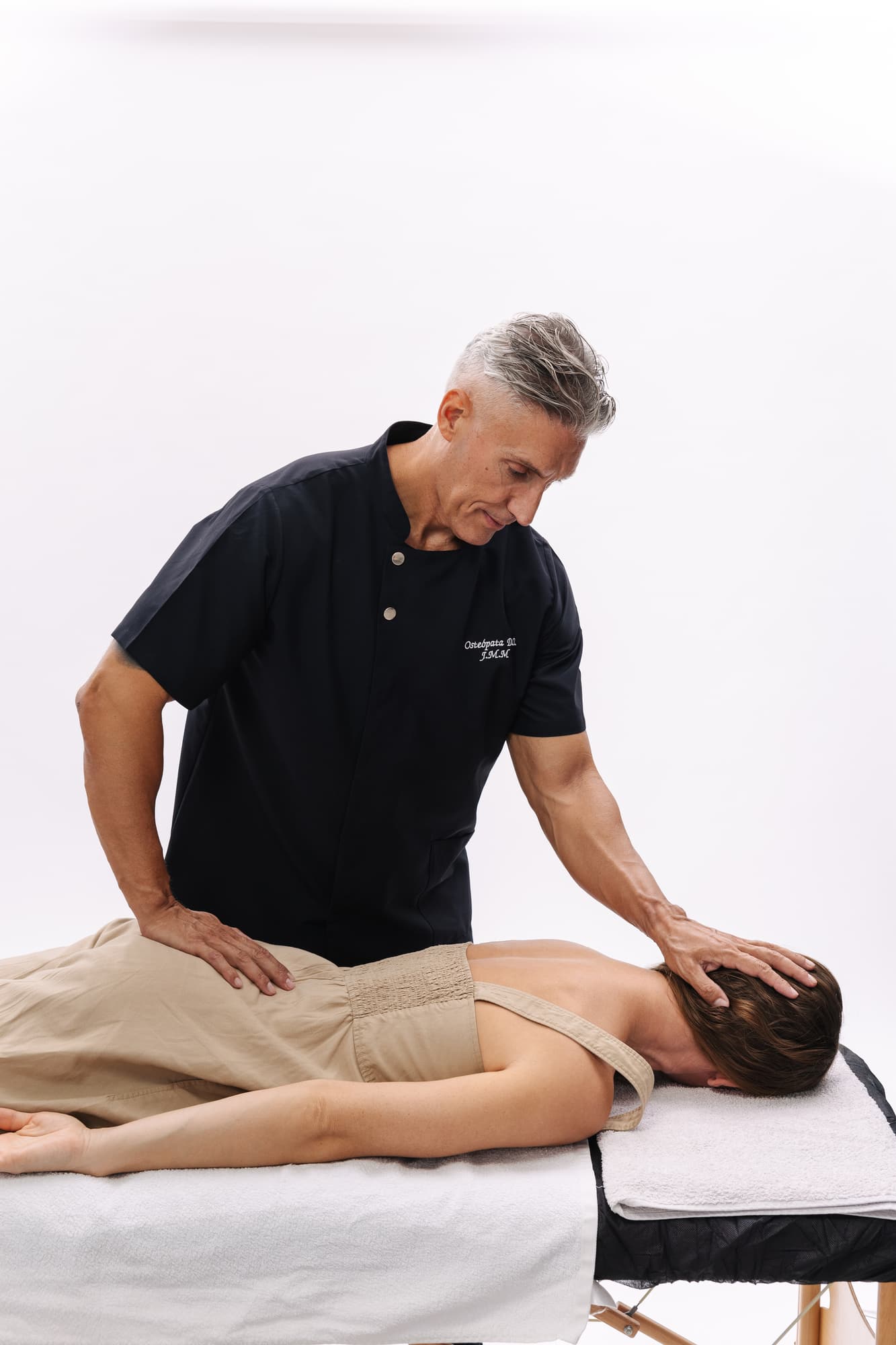
My sessions are hands-on and thorough. I also give you personalised posture advice and home exercises. I explain them and we practise them together so you can ask me anything you need.
What your doctor decides
Diagnosis, decisions about tests and medication belong to your doctor. I will not interfere with your doctor’s decision.
The osteopathy page explains more about the way I work. The next two sections contain general information, not part of what I do in a session.
Staying active with lumbago
Keep up everyday activities where possible. Bed rest is not recommended. That does not mean you have to make every movement you normally would, at the same intensity, from the first day.
Everyday activity and returning to exercise
Normal activity can be reduced during the first few days. A gradual return to exercise is generally suggested at two to three weeks, starting with light aerobic activity such as walking, a stationary bike or swimming. During the first six weeks, avoiding heavy lifting and twisting your back is recommended.
These are general suggestions for an acute episode, not a timetable drawn up for you. Keeping up some everyday activity and returning to exercise are separate decisions. If you are unsure how this advice fits your circumstances, discuss it with your doctor.
Choosing an activity
One option is a group exercise programme that takes account of your needs, preferences and capabilities. It can focus on strength and movement, aerobic activity, mind and body, or a combination. Walking, swimming, yoga and pilates are examples of activities for staying active.
Choosing an activity means taking account of what you can do now. The warning signs in the earlier box take priority over any general advice about staying active.
Back exercises and stretches are another option. Stop if the pain gets worse.
Lumbago exercises: general information and four examples
These are four common movements, described and drawn for this page. This is general information, not a programme for your case.
Before you start, read when to see a doctor or call 112. Move slowly and only as far as feels comfortable. Stop if the pain increases or spreads to your leg. If you’re unsure whether these movements suit you, ask your doctor.
These are general examples, not movements chosen for your case. In the drawings, grey marks the start and the dark line marks the end.
Knee roll stretch
Knees upright and to one side Start: on your back, with the soles of your feet on the floor and your knees pointing upwards. End: your knees are tilted to one side, with your back resting on the floor.
Knees to chest stretch
Knees bent and towards the chest Start: on your back, with your feet on the floor and your legs bent. End: your feet are off the floor and your knees are closer to your chest. Your hands are behind your thighs.
Bridge
Hips down and hips raised Start: with your hips on the floor, facing upwards with your legs bent. End: your hips are raised, with your feet and shoulders resting on the floor.
Side bend stretch
Standing upright and bending sideways Start: standing upright, with your arms beside your body. End: your upper body is tilted to one side. The hand on that side is further down beside your thigh.
If a movement makes symptoms worse, stop and speak to your doctor. For a warning sign, follow the urgent-care box.
If you come with lumbago: the first visit
Lumbago is one of the reasons people contact me.
Your first appointment is called the Comprehensive Body Assessment. It includes a case history, a full check and some first hands-on work.
Tell me where you want the visit
Message me on WhatsApp or call. Give me your town and say whether you would prefer the clinic or a home visit. We agree a day and time.
I listen and assess your case
In the case history I ask about your health history. I observe and listen to you, assess your case and do some first hands-on work.
I don’t work on one area in isolation: I look at your body as a single, indivisible unit.
I recommend seeing your doctor when needed
If I have doubts or cannot work on your case, I recommend seeing your doctor. If in doubt, or if it is serious, it is best to see the doctor first and then the osteopath; if you decide to come to the osteopath first, I can also advise you on what to do first. I may suggest you see your doctor, in case you need tests.
Prices
Clinic, home visits and prices
- First clinic appointment: €70. Comprehensive Body Assessment, 60 min.
- First home appointment: €120. Comprehensive Body Assessment.
- Osteopathy at the clinic: €70 per session.
- A home session: from €100. No distance charge up to Estepona. The price list linked below includes the terms and cancellation rules.
- Russian or Ukrainian translator, on request: book her 5 hours in advance. You pay an extra €60 per session. For an urgent visit, the translator can come subject to availability.
I accept cash, Bizum and bank transfers. I don’t work with insurers. See the full price list.
You’ll find me at C/ Ilusión 17, in Fuente Nueva. Visits to the San Pedro de Alcántara clinic are by appointment only. A free car park with an unpaved surface is 50 m away.
For a home visit, I come to your home, hotel or villa. I cover San Pedro, Marbella (including Nueva Andalucía and Puerto Banús), Benahavís and Estepona. Estepona visits need prior notice.
For medical emergencies, call 112.
To arrange an appointment, message me or call.
Frequently asked questions
Lumbago: frequently asked questions
Is lumbago the same as lower back pain?
Yes, lumbago means pain in the lower part of your back. The word tells you where it hurts. On its own, it does not identify the cause or replace your doctor’s diagnosis.
Should I stay in bed until it passes?
Bed rest is not recommended. Keep up everyday activities where possible. That does not mean following an exercise routine if it makes the pain worse. Warning signs need medical attention.
Do I need to bring an X-ray or MRI scan?
You do not need any tests to book an appointment. Bring any reports or test results you already have from your doctor or a specialist; if you have none, that is fine. Your doctor decides whether you need tests.
What if I’ve recently had an operation?
Your doctor has the final say. We start once your doctor has discharged you, following all their instructions and safety requirements.
Can I try the movements if it hurts a lot?
If the pain is severe, check the warning signs first: sudden severe pain or pain that worsens rapidly needs urgent medical attention. The movements should stay comfortable. If one makes the pain worse, stop and speak to your doctor.
What details do you need to arrange the appointment?
Tell me your town and whether you’d prefer an appointment at my practice or a home visit. Don’t send diagnoses, reports or test results by message.
Sources
- World Health Organization (WHO), “Low back pain”, fact sheet, 19 June 2023. Accessed 8 November 2026. Used for: how common it is and types.
- MedlinePlus, “Lumbago agudo” (Spanish), reviewed 27 June 2026. Accessed 8 November 2026. Used for: duration and general activity guidance.
- NHS, “Back pain”, reviewed 5 March 2026. Accessed 8 November 2026. Used for: warning signs and staying active.
- NICE, “Low back pain and sciatica in over 16s: assessment and management”, NG59 (2016), updated 29 July 2026; recommendations 1.1.4, 1.2.1 and 1.2.2. Accessed 8 November 2026. Used for: imaging and group exercise.
Tell me what kind of visit you need and where
Phone +34 672 29 91 22
To arrange a visit, tell me your town and whether you prefer the clinic or a home visit. Don’t send diagnoses, reports or medical test results by message.
Clinic in San Pedro de Alcántara, by appointment only; home visits in San Pedro, Marbella, Benahavís and, with prior notice, Estepona. Monday to Sunday, 8:00 AM–8:00 PM.
I do the sessions in Spanish or English.